
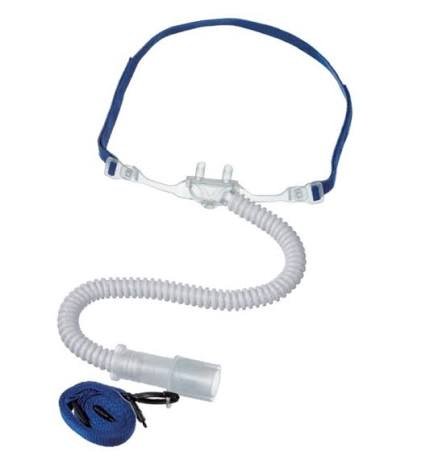
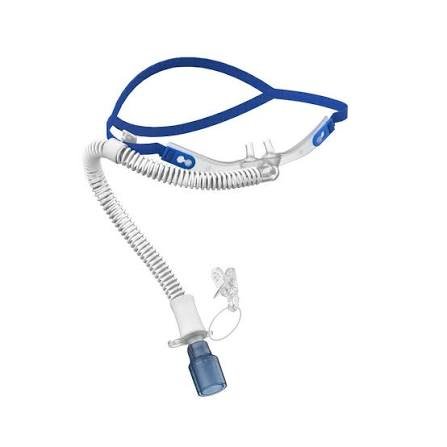
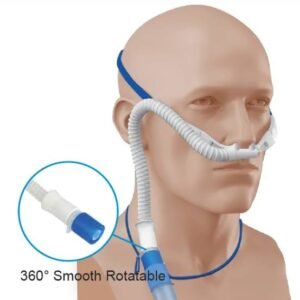
When standard oxygen interfaces fall short, an advanced high flow nasal cannula machine bridges the gap by delivering highly accurate, climate-controlled gas blends directly to the patient. Widely integrated across intensive care units, emergency wards, and specialized home healthcare configurations, HFNC therapy optimizes alveolar recruitment and drastically improves patient comfort.
Key Clinical Strengths & System Operations:
-
High Flow Nasal Cannula Flow Rate Power: Unlike standard low-flow nasal cannulas capped at 6 L/min, specialized HFNC systems allow a high flow nasal cannula flow rate spanning from 2 to 60 L/min. This effectively meets or exceeds the patient’s intrinsic inspiratory peak flow demand.
-
High Flow Nasal Cannula vs BiPAP: While BiPAP utilizes a tight, closed face mask to offer distinct dual-pressure support ($IPAP / EPAP$), it often causes claustrophobia or skin breakdown. Conversely, an HFNC uses soft, open nasal prongs that flush anatomical dead space, create a modest positive end-expiratory pressure ($PEEP$), and allow the patient to eat and speak seamlessly during treatment.
-
Dynamic Therapeutic Settings: Precise clinical control over high flow nasal cannula settings lets respiratory teams independently tune three critical factors: total flow rate (L/min), fraction of inspired oxygen ($FiO_2$), and target humidification temperature (typically 31°C to 37°C) to prevent raw or dry mucosal airways.
Clinical Protocol Matrix: Adult HFNC Settings & FiO2 Chart
The standard high flow nasal cannula protocol for adults dictates scaling clinical parameters based on real-time respiratory tracking and blood gas metrics. The following reference chart highlights baseline titrations:
| Clinical Stage / Phase | Flow Rate Target | FiO2 Range Setting | Target Humidification Temp | Clinical Objective |
| Initial ICU Setup | 40 to 50 L/min | 60% to 100% | 37°C | Rapidly reverse hypoxemia and flush airway dead space. |
| Maintenance / Adjustment | 30 to 40 L/min | Titrated (35% – 60%) | 34°C – 37°C | Maintain target $SpO_2$ (92%–96%) while lowering oxygen load. |
| Weaning Protocol | 15 to 25 L/min | Under 35% | 31°C | Gradually transition patient back to standard low-flow oxygen therapy. |
High Flow Nasal Cannula Machine Price in Pakistan (2026 Rates)
We provide specialized hospital procurements, premium system rentals, and complete consumable supply setups across all major cities:
| Equipment / System Component | Estimated Price Range (PKR) | Same-Day Logistics / Delivery Locations |
| Premium HFNC Machine Unit (e.g., Fisher & Paykel Airvo 2) | Rs. 450,000 – Rs. 750,000 | Lahore, Karachi, Islamabad, Rawalpindi |
| Advanced HFNC Machine (Standard Brand) | Rs. 280,000 – Rs. 420,000 | Karachi, Multan, Faisalabad, Peshawar |
| Adult High-Flow Patient Circuit & Cannula Kit | Rs. 8,500 – Rs. 14,000 | Nationwide Shipping (Pakistan) |
| ICU/Home HFNC Therapy Management (Per Day) | Rs. 8,000 – Rs. 20,000 | Lahore, Karachi, Islamabad |
Frequently Asked Questions (FAQs)
1. How does the High Flow Nasal Cannula generate PEEP?
The system creates a mild positive airway pressure ($PEEP$) effect through the high-volume velocity of gas entering the nose. For every 10 L/min of flow delivered with a closed mouth, approximately $0.5\text{ to }1\text{ cmH}_2\text{O}$ of positive pressure is established, helping to hold open the alveoli.
2. Where can I source authentic HFNC consumable circuits in Islamabad or Rawalpindi?
We offer immediate delivery for specialized heated breathing tubes, auto-fill water chambers, and premium adult high-flow cannulas across all major hospitals and private care setups in Rawalpindi, Islamabad, Lahore, and Karachi.
3. When should a patient be stepped up from an HFNC machine to a BiPAP or Ventilator?
If a patient shows worsening signs of respiratory distress, severe hypercapnia (high $CO_2$ retention), or an inability to maintain $SpO_2$ above 88% despite the machine operating at its maximum settings (60 L/min flow and 100% $FiO_2$), they must be re-evaluated for BiPAP or endotracheal intubation immediately.
Reviews
There are no reviews yet.