
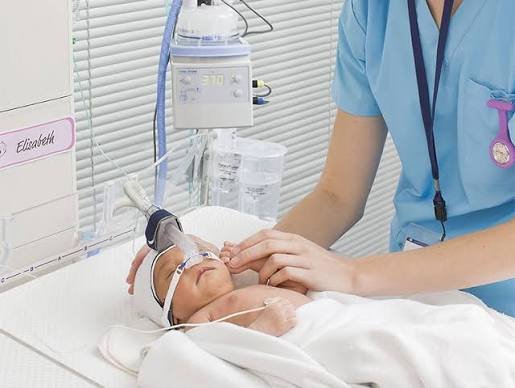
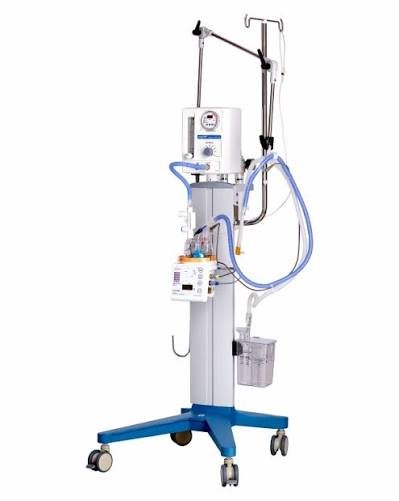
Managing neonatal respiratory distress syndrome (RDS) demands specialized clinical precision. A bubble cpap machine stands as a cornerstone therapy in infant intensive care units, bridging critical physiological gaps safely without mechanical ventilation. By routing a continuous gas blend through a fluid column, the system generates natural pressure oscillations that protect infant lung tissue.
Key Technical & System Components:
-
Bubble CPAP vs CPAP: While a standard adult CPAP machine relies on electronic motorized valves to maintain a fixed pressure, a bubble cpap nicu system passes exhaled air underwater. The resulting bubbles create continuous pressure oscillations that gently vibrate the infant’s airway, enhancing gas exchange and lung recruitment.
-
Bubble CPAP PEEP Control: The exact positive end-expiratory pressure (PEEP) is mechanically determined by the depth of the tube submerged in the water column. Clinicians can adjust clinical bubble cpap settings safely by changing the water level, typically aiming for pressures between $4\text{ cmH}_2\text{O}$ and $8\text{ cmH}_2\text{O}$.
-
Premium Bubble CPAP Circuit Design: High-efficiency therapy depends entirely on a specialized bubble cpap circuit. Our medical-grade, heated-wire breathing circuits minimize condensation (rainout) while delivering warm, fully humidified oxygen to protect delicate mucous membranes.
-
Anatomical Infant Interface: Using a specialized bubble cpap mask or ultra-soft silicone nasal prongs ensures a secure seal without applying excessive pressure to the newborn’s fragile facial structure or nasal septum.
Technical Setup & Parameters: Bubble CPAP Settings
| Clinical Parameter | Standard Operational Baseline | Purpose / Function |
| Flow Rate Settings | 4 to 10 L/min | Meets infant inspiratory demand and maintains system pressure. |
| PEEP Level ($H_2O$) | $4\text{ to }8\text{ cmH}_2\text{O}$ (Submersion depth) | Prevents alveolar collapse and maintains lung capacity. |
| Gas Temperature | 35°C to 37°C (Heated Humidifier) | Mimics body temperature to prevent airway cooling and drying. |
| $FiO_2$ (Oxygen Blend) | 21% to 100% (Adjustable via Blender) | Delivers precise oxygen percentages based on $SpO_2$ feedback. |
Bubble CPAP Machine Price in Pakistan (2026 Procurement Rates)
We supply comprehensive medical setups, replacement bubble cpap parts, and consumables directly to clinical institutions and private home care setups:
| Equipment System Component | Estimated Price Range (PKR) | Same-Day Delivery / Dispatch Locations |
| Complete Bubble CPAP Machine Setup (Includes Blender & Humidifier) | Rs. 240,000 – Rs. 480,000 | Lahore, Karachi, Islamabad, Peshawar |
| Premium Disposable Bubble CPAP Circuit | Rs. 4,500 – Rs. 7,500 | Multan, Rawalpindi, Faisalabad, Lahore |
| Silicone Bubble CPAP Mask / Nasal Prongs | Rs. 3,800 – Rs. 6,000 | Nationwide Delivery (Pakistan) |
| Replacement Water Chamber / Parts | Rs. 5,500 – Rs. 9,000 | Nationwide Delivery (Pakistan) |
Frequently Asked Questions (FAQs)
1. Why is a bubble CPAP machine preferred over traditional ventilators in the NICU?
A bubble cpap nicu setup is significantly less invasive than mechanical ventilation. The pressure waves created by the bubbling action lower the work of breathing, protect the infant’s lungs from barotrauma, and stimulate natural surfactant production.
2. Where can I source authentic bubble CPAP parts in Karachi and Lahore?
We offer immediate delivery of original replacement bubble cpap parts, including heated wire circuits, water chambers, air-oxygen blenders, and interface masks across Lahore, Karachi, Rawalpindi, and Multan.
3. How do you clean and maintain a bubble CPAP circuit safely?
The single-patient bubble cpap circuit and nasal interfaces must be checked daily for fluid accumulation. Regular replacement of the sterile water inside the pressure generator and humidifier chambers is vital to prevent bacterial growth and cross-contamination within clinical settings.
Reviews
There are no reviews yet.