
Selecting the appropriate medical furniture is a fundamental milestone when configuring a healthcare facility or organizing a specialized medical environment for a loved one at home. Hospital procurement teams and family caregivers setting up high-level home care suites frequently encounter the same vital question: what is the difference between patient bed and icu bed?
While standard ward beds and Intensive Care Unit (ICU) beds might appear visually similar to an untrained eye, their underlying design engineering, operational capabilities, and clinical functions are vastly different. A standard ward bed is built to maximize basic patient comfort and facilitate routine nursing assistance. Conversely, a medical ICU bed acts as an active, high-intensity therapeutic platform engineered to support critically ill individuals requiring continuous life-support integration.
Whether you are configuring a clinical wing or evaluating home care setups in Pakistan, this detailed guide breaks down the essential technical parameters, core features, and 2026 market pricing structures to help you make an informed decision.
The Core Design Philosophy: General Care vs. Critical Intervention
The primary difference between patient bed and icu bed stems from the specific patient acuity level each system is engineered to accommodate.
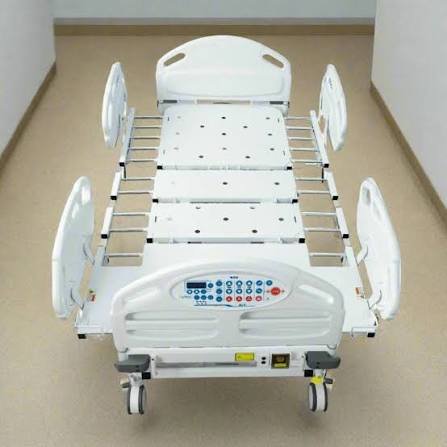
Standard Patient Beds
Standard patient beds form the baseline infrastructure of general medical floors, outpatient recovery wards, and long-term rehabilitation clinics. Their main purpose is to provide a stable, comfortable surface that allows the patient to rest safely while giving nursing staff straightforward options to alter positions. These beds rely on simple mechanical architecture—using manual cranks or basic electric actuators—to modify fundamental segments like the headrest or knee elevation.
Medical ICU Beds
An Intensive Care Unit bed is categorized as an active medical device rather than basic clinical furniture. These platforms are designed for patients experiencing unstable, life-threatening conditions who require complex connections with secondary devices like mechanical ventilators, syringe pumps, and telemetry monitors. Their chassis are engineered from specialized, high-tensile materials that ensure thermosensitive load bearing stability, keeping the framework rigid during aggressive medical interventions.
Head-to-Head Feature Comparison
To help you choose the right system, let’s look at the specific functional differences that separate these two classes of medical furniture:
1. Motorized Articulation and Positional Flexibility
Standard beds are typically restricted to basic movements. They are widely distributed through local markets as 1-function, 2-function, or electric 3 function hospital bed karachi options. These functions are limited to raising the backrest, lifting the knees to reduce lower-back strain, and modifying the total deck height above the floor.
In comparison, an advanced ICU bed is a 5-function or 7-function motorized workstation capable of moving along multiple axes to provide critical positions:
- Trendelenburg and Reverse Positions: This allows the entire bed deck to tilt flat at an angle where the head is positioned lower than the feet, or vice versa. These sudden shifts are vital for managing rapid drops in blood pressure, promoting venous return, and establishing tracheal airway patency positioning during acute respiratory crises.
- Lateral Tilt Profiles: Highly advanced ICU systems can gently tilt the patient along a longitudinal axis to the left or right side. This automated movement plays a vital role in lateral tilt pressure ulcer prevention (bedsores) for completely immobile or paralyzed patients, redistributing interface pressure without needing manual handling by caregivers.
2. Emergency Response Integration (Mechanical CPR Release)
During a medical emergency, such as sudden cardiac arrest, standard beds can create dangerous delays. If a patient is on a standard bed with an elevated backrest, the nurse must manually crank the section down or wait for a standard electric motor to slowly lower the frame before beginning chest compressions.
ICU beds eliminate this delay with a dedicated cardiopulmonary resuscitation manual override handle located near the head panel. Pulling this high-visibility lever instantly disengages the motorized gears, dropping the backrest flat in a fraction of a second so the resuscitation team can start chest compressions immediately on a rigid surface.
3. Integrated Diagnostics and Safety Telemetry
Modern ICU beds feature built-in electronics and diagnostic sensors designed to minimize patient handling and protect them from accidental falls:
- Integrated Weighing Scales: Monitoring strict fluid retention and dosage metrics requires highly accurate body weight tracking. Built-in digital scale systems allow clinicians to capture the patient’s exact mass without lifting them off the mattress or disconnecting sensitive iv lines.
- Patient Exit Safety Alarms: If a disoriented, sedated, or neurologically compromised patient attempts to step off the mattress or move past the protective boundaries, integrated sensors trigger immediate alerts at the nurse’s station to prevent accidental falls.
Technical Comparison Matrix
| Clinical & Structural Dimensions | Standard Ward Patient Bed | Advanced Medical ICU Bed |
| Operation Type | Manual Cranks or Basic Electric | Fully Electric Remote & Nurse Panel Controls |
| Positional Functions | 1 to 3 Function Adjustments | 5 to 7 Advanced Functions (Trendelenburg) |
| Emergency CPR Release | Mechanical Override Absent | Dedicated One-Touch Quick CPR Handle |
| Frame & Load Capacity | Standard Steel Frame ($120\text{ to }170\text{ kg}$) | Heavy-Duty Reinforced Construction ($\ge 250\text{ kg}$) |
| Side Rails Security | Simple Collapsible Aluminum Rails | Foldable ABS Plastic Rails with Integrated Controls |
| Braking Mechanism | Individual Wheel Caster Locks | Central Braking System with Directional Lock |
| Imaging Compatibility | Limited or Non-Radiolucent | Radiolucent Backrest for Bedside X-Rays |
2026 Market Pricing Guide in Pakistan
The ICU hospital bed price in Pakistan is influenced by its functional capacity, country of origin, structural electronics, and whether you choose to purchase or lease through a specialized medical equipment rental islamabad agency.
Below is the verified retail pricing framework across major medical supply networks for 2026:
| Bed Type & Functional Profile | Estimated Purchase Price (PKR) | Average Monthly Rental (PKR) | Ideal Implementation Environment |
| Manual 2-Function Patient Bed (Backrest & Knee-rest via manual cranks) | Rs. 35,000 – Rs. 55,000 | Rs. 4,500 – Rs. 6,500 | Simple home care, stable fracture recovery wards. |
| Electric 3-Function Bed (Motorized height, back, and leg controls) | Rs. 115,000 – Rs. 165,000 | Rs. 12,000 – Rs. 16,000 | Semi-independent stroke patients, elderly home care. |
| Imported 5-Function Electric ICU Bed (ABS panels, CPR release, Trendelenburg) | Rs. 265,000 – Rs. 395,000 | Rs. 25,000 – Rs. 35,000 | Post-ICU shift, long-term non-invasive ventilation. |
| Premium Intelligent ICU Workstation (Integrated scale, lateral tilt, X-ray deck) | Rs. 650,000 – Rs. 1,200,000+ | Rarely Rented | Multi-specialty hospital ICU wards, cardiac units. |
Supply Chain Sourcing & Procurement Strategies
Sourcing hospital beds in Pakistan requires balancing localized manufacturing capabilities with certified international standards to ensure product longevity.
- Buy Manual Patient Bed Lahore Hubs: For traditional manual beds or basic outpatient furniture, local hospital furniture manufacturers around the Nila Gumbad and Mayo Hospital distribution grids offer durable options.
- Electric 3 Function Hospital Bed Karachi Imports: When sourcing multi-function electric platforms, ensure your importer provides an electrical compliance certificate. Power surges are common in urban centers, meaning the electronic actuators require surge-protected power strips or dedicated voltage stabilizers to protect the internal circuitry.
- Medical Equipment Rental Islamabad Support: For families managing temporary palliative care or post-operative home rehabilitation in the capital region, monthly leasing programs offer a cost-effective alternative to purchasing heavy machinery outright.
Summary and Final Checklist
Ultimately, choosing the right bed depends on your patient’s specific medical needs. If the individual is respiratory-stable and simply has limited mobility, an electric 3-function bed provides an excellent balance of independence and comfort. However, if the patient is on a mechanical ventilator, has volatile cardiac metrics, or requires frequent emergency position shifts, an authentic 5-function ICU bed is essential to support their care safely.
Ready to view our inventory of specialized manual and fully electric beds? Explore our options on the comprehensive hospital furniture and ward matrix, or submit your patient’s medical summary directly through our clinical consultation and support page so our engineers can assist you in selecting the ideal setup.
Frequently Asked Questions (FAQs)
Q1: Do ICU beds require a specialized medical mattress?
Yes, they do. ICU beds are almost always paired with dynamic, high-density pressure relief mattresses, such as alternating-pressure ripple air mattresses. Because ICU patients are completely immobile for long periods, these systems continuously adjust air pockets to prevent bedsores and deep tissue breakdown.
Q2: What is the clinical benefit of a radiolucent backrest in an ICU bed?
A radiolucent backrest allows X-ray beams to pass through the bed frame clearly. This enables medical teams to perform critical chest radiographs right at the bedside using a portable C-arm machine, eliminating the need to move an unstable patient down to the radiology department.
Q3: Can an electric ICU bed run on a standard Pakistani home electrical socket?
Yes, imported electric ICU beds are designed to run on standard domestic $220\text{V}$ alternating current (AC) outlets. Their power draw is lower than a standard kitchen appliance. However, using a small voltage stabilizer is highly recommended to protect the sensitive control panels from power spikes.
Q4: Why are the ABS headboards and footboards on ICU beds designed to be removable?
The headboards on ICU beds are designed to lift off instantly without using tools. This ensures that during an emergency intubation or resuscitation procedure, the anesthesia or emergency team can stand directly behind the patient’s head to secure the airway without obstruction.