
Navigating the world of sleep medicine after receiving an obstructive sleep apnea (OSA) diagnosis can feel overwhelming. Once your pulmonologist confirms that you require positive airway pressure to stabilize your nighttime breathing, the next critical step is selecting the right equipment. The decision almost always comes down to a central debate: CPAP vs BiPAP.
While both devices are designed to deliver targeted sleep apnea care at home, they handle pressure delivery in fundamentally different ways. At Respiratory Store & Sleep Solution, we believe that understanding these CPAP vs BiPAP medical differences is vital to ensuring maximum comfort and therapy compliance. In this comprehensive guide, we will break down how each machine works, look at their technical features, and help you understand which system will work best for your lungs.
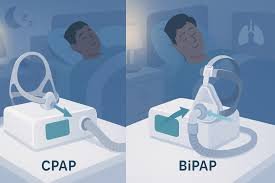
The Core Engineering Differences: How They Work
To understand which machine is right for you, we have to look at how these respiratory support devices manage air pressure while you sleep.
1. Continuous Positive Airway Pressure (CPAP)
A CPAP machine is the most common and widely prescribed device for standard sleep apnea. It delivers a single, fixed level of pressurized air through your tubing and mask. This constant stream acts as an invisible air splint that physically holds your throat open, preventing airway collapse regardless of whether you are breathing in or breathing out. Modern models, like the premium ResMed AirSense 10 Auto, feature smart expiratory pressure relief settings (EPR) that drop the pressure slightly when you exhale to make breathing out feel more natural.
2. Bilevel Positive Airway Pressure (BiPAP)
A BiPAP device is a more advanced bilevel pressure therapy device. Instead of a single constant setting, it features two distinct pressure levels:
- IPAP (Inspiratory Positive Airway Pressure): A higher pressure setting that assists you when you draw air into your lungs.
- EPAP (Expiratory Positive Airway Pressure): A significantly lower pressure setting that makes it incredibly easy to exhale without fighting against a heavy incoming stream of air.
Head-to-Head Comparison: CPAP vs. BiPAP
| Technical Parameter | CPAP Machine Setup | BiPAP Machine Setup |
| Pressure Profiles | Single fixed or auto-adjusting pressure level ($4 – 20\ cmH_2O$) | Dual customized pressure levels (IPAP and EPAP up to $25 – 30\ cmH_2O$) |
| Primary Exhalation Feel | Requires pushing back against the incoming pressurized air stream | Automatically drops pressure instantly upon exhalation for total comfort |
| Ideal Clinical Target | Standard Obstructive Sleep Apnea (OSA) cases | Complex Sleep Apnea, COPD, OHS, or chronic respiratory issues |
| Average Device Cost | Highly affordable auto CPAP price in Pakistan options | Higher financial investment due to complex dual-motor setup |
| Backup Respiratory Rate | No backup breath-timing features available | Available in advanced models to trigger breaths automatically if breathing stops |
Who Benefits Most from a Standard CPAP Machine?
For the vast majority of individuals entering a sleep apnea machine comparison, an auto-adjusting CPAP machine works perfectly. It is highly efficient, compact, and completely resolves simple upper airway blockages.
If your prescribed pressure setting is relatively low (e.g., under $12\ cmH_2O$), a CPAP machine with a high-quality heated sleep apnea humidifier will keep your nasal passages comfortable and clear throughout the night. You can review our entry-level and premium configurations directly on our specialized CPAP rental and pricing page.
Who Absolutely Needs a BiPAP Machine?
While CPAP is highly effective for standard airway blocks, certain medical profiles require the advanced inhalation and exhalation support of a BiPAP system:
- High-Pressure Intolerance: If your doctor prescribes a very high pressure setting (e.g., $15\ cmH_2O$ or above), exhaling against that constant stream on a standard CPAP can feel exhausting or cause anxiety. BiPAP resolves this by instantly dropping the pressure when you blow out.
- Chronic Respiratory Failure Solutions: Patients struggling with severe lung disorders like COPD or Obesity Hypoventilation Syndrome (OHS) retain dangerous amounts of carbon dioxide. BiPAP actively helps pump out that toxic gas. Learn more about managing these restrictive lung issues by reviewing our clinical guide on OSA vs OHS medical differences.
- Central Sleep Apnea (CSA): Unlike OSA, where the throat blocks up mechanically, Central Sleep Apnea happens when the brain temporarily forgets to signal the chest muscles to breathe. Advanced BiPAP machines track this and step in to deliver a timed breath.
Sourcing Your Equipment Across Pakistan
Because buying these devices outright involves a significant investment, utilizing Respiratory Store & Sleep Solution rental options allows you to access premium medical technology with zero upfront stress. Whether you need a top-tier Philips DreamStation BiPAP or a budget-friendly BMC medical devices Pakistan kit, we cover your logistics seamlessly:
- Rent CPAP Machine Islamabad: Twin-cities residents can book rapid doorstep delivery and professional calibration via our dedicated Islamabad branch directory.
- BiPAP and CPAP Rental Karachi: Coastal patients can access 24/7 emergency technical support and setup configurations by visiting our localized Karachi delivery and terms page.
- Medical Equipment Rental Lahore: Lahore residents can visit our primary showroom for custom mask fittings, pressure trials, and tech diagnostics. View our exact address on the Lahore main showroom location page.
Conclusion: Trust Your Medical Prescription
When determining which machine works best, the final choice always rests on your individual medical diagnostics. A CPAP machine is the ultimate, cost-effective solution for structural throat blockages, while a BiPAP machine is a highly specialized asset engineered to manage complex airway restrictions, muscle exhaustion, and gas exchange issues.
Ready to find your perfect fit? Explore our complete line of certified, sterile inventory on our comprehensive BiPAP and CPAP product catalog, or connect with our clinical support specialists through our contact and consultation hub to arrange an in-home trial today.
Frequently Asked Questions (FAQs)
Q1: Can I switch from a CPAP to a BiPAP machine if I find it too hard to breathe out?
Yes. This is one of the greatest benefits of renting through Respiratory Store & Sleep Solution. If you experience chest muscle soreness or feel like you are suffocating while exhaling on a CPAP, contact our team to easily upgrade your package to a dual-pressure BiPAP device.
Q2: Is a doctor’s prescription mandatory to rent a BiPAP machine?
Absolutely. Because a BiPAP operates using two separate critical pressure levels (IPAP and EPAP), these parameters must be precisely programmed based on data from an official sleep study or your pulmonologist’s explicit medical directions.
Q3: Do your rental machines include a heated sleep apnea humidifier?
Yes. All of our premium rental units—whether CPAP or BiPAP—come equipped with integrated heated humidifiers to prevent mouth dryness, nasal congestion, and airway irritation. You can read about our strict device standards on our quality assurance page.
Q4: What is the main structural difference between an Auto-CPAP and a fixed CPAP?
A fixed CPAP delivers one set pressure all night long. An Auto-CPAP continuously tracks your breathing patterns breath-by-breath and automatically raises or lowers the pressure to match your shifting sleep stages and sleeping positions.
Q5: How can I look up specific rental rates for ResMed and Philips devices?
We offer transparent weekly and monthly packages designed to accommodate various medical durations. You can view all updated rates by checking our centralized rental pricing directory. Contact Now