
Starting positive airway pressure therapy can feel overwhelming. Many patients in Pakistan invest in high-end therapeutic machines—such as a ResMed AirSense 10 or a Philips DreamStation—only to abandon treatment within weeks due to air leaks, facial pressure sores, or mouth dryness.
The underlying culprit is rarely the machine itself; in over 80% of clinical cases, it is an improperly selected or fitted mask.
Whether you need a lightweight nasal pillow mask or a full face mask designed for higher pressure therapy, understanding CPAP mask price in Pakistan, mask styles, and device compatibility is essential for a comfortable night’s sleep.
This guide breaks down mask types, addresses clinical questions regarding CPAP vs. BiPAP therapy, and outlines pricing across Lahore, Islamabad, Rawalpindi, and Karachi.
1. Demystifying the Terminology: CPAP and BiPAP Full Form
Before selecting a mask interface, it helps to understand the medical abbreviations and core mechanisms of respiratory support systems.
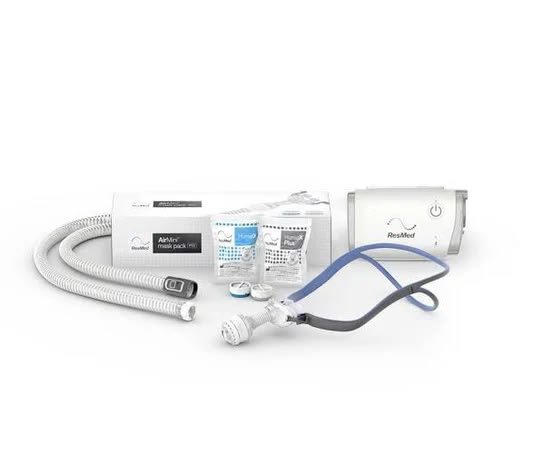
- CPAP Full Form: Continuous Positive Airway Pressure. CPAP delivers a continuous stream of pressurized air set at a single pressure level ($cmH_2O$) to prevent upper airway collapse during sleep.
- BiPAP Full Form: Bilevel Positive Airway Pressure (also known as BPAP). BiPAP delivers two alternating pressure levels: a higher pressure during inhalation and a lower pressure during exhalation.
2. Main Difference Between CPAP and BiPAP Systems
Understanding the main difference between CPAP and BiPAP helps explain why specific masks are prescribed for different therapies.
BiPAP vs. CPAP Indications
- CPAP Indications: Recommended for mild, moderate, and severe Obstructive Sleep Apnea (OSA) where upper airway obstruction is the primary issue.
- BiPAP Indications: Prescribed when patients require higher therapeutic pressures ($>15 \text{ } cmH_2O$), struggle to exhale against CPAP pressure, or suffer from underlying respiratory conditions like Chronic Obstructive Pulmonary Disease (COPD), Congestive Heart Failure (CHF), Central Sleep Apnea (CSA), or Obesity Hypoventilation Syndrome (OHS).
Is BiPAP More Comfortable Than CPAP?
Yes, for patients who require higher therapeutic pressure. Because BiPAP automatically drops the pressure when you exhale (EPAP), it eliminates the sensation of “fighting against the incoming air.” This makes exhalation feel natural and significantly improves compliance for sensitive users.
3. Difference Between BiPAP and CPAP and Ventilator Systems
Patients and caregivers often wonder: Where do these devices fit on the spectrum of medical respiratory support?
- CPAP Machine: Operates non-invasively via a mask cushion. Keeps the soft tissue in the throat open. The patient does all the physical work of breathing.
- BiPAP Machine: Operates non-invasively via a nasal or full face mask. It actively assists muscle work during breathing by boosting pressure during inhalation (IPAP) and reducing it during exhalation (EPAP).
- Mechanical Ventilator: Used in intensive care units (ICU) or specialized home-care environments. Ventilators can operate invasively (via a tracheostomy tube) or non-invasively. They feature advanced life-support algorithms, external battery backups, and internal safety alarms to handle total respiratory failure.
4. Is CPAP or BiPAP More Serious?
A common point of confusion is whether being prescribed a BiPAP unit means a patient’s condition is “more serious.”
In terms of clinical scope, BiPAP therapy is generally associated with more complex health conditions. While CPAP treats physical upper airway obstructions in sleep apnea, BiPAP is used for complex respiratory failure, neuromuscular diseases (such as ALS), high-level central sleep apnea, and hypercapnia (carbon dioxide retention).
5. How Long Can Someone Live on a BiPAP Machine?
When a family member is prescribed non-invasive positive pressure ventilation (NIPPV) for chronic lung failure or neuromuscular conditions, caregivers often ask: How long can someone live on a BiPAP machine?
BiPAP therapy is a non-invasive support treatment rather than a end-of-life measure. Patients can live on BiPAP therapy comfortably for many years—and often decades.
- For Sleep Apnea & COPD: BiPAP is used nightly during sleep. Regular use restores normal blood oxygen levels ($SpO_2$), flushes trapped carbon dioxide ($CO_2$), and reduces strain on the heart, significantly extending life expectancy.
- For Progressive Neuromuscular Conditions: Patients may use BiPAP for 8 to 16 hours a day over many years, maintaining lung volume and improving their quality of life.
6. BiPAP and CPAP Mask Types: Choosing the Right Cushion
Selecting the right mask geometry is critical for preventing air leaks, skin breakdown, and therapy disruption.
A. Nasal Pillow Masks
- Design: Compact silicone cones fit directly into the nostrils.
- Best For: Active sleepers, individuals with facial hair, people who read or watch TV before bed, and patients prescribed lower CPAP pressures ($<10 \text{ } cmH_2O$).
- Popular Models: ResMed AirFit P10, Philips DreamWear Nasal Pillow.
B. Nasal Masks
- Design: Covers the entire nose, seating comfortably over the bridge of the nose to the upper lip.
- Best For: High-pressure CPAP users who breathe through their nose, side-sleepers, and patients who find nasal pillows uncomfortable.
- Popular Models: ResMed AirFit N20, Philips Respironics Wisp.
C. Full Face (Oronasal) Masks
- Design: Covers both the nose and mouth.
- Best For: Mouth breathers, patients with chronic nasal congestion, and individuals on high-pressure BiPAP therapy ($>15 \text{ } cmH_2O$).
- Popular Models: ResMed AirFit F20 / F30, BMC F1B Full Face.
CPAP Mask Price in Pakistan (2026 Price Comparison)
Mask costs in Pakistan vary depending on the manufacturer (ResMed, Philips Respironics, BMC), material quality (medical-grade silicone vs. memory foam), and cushion style.
| Mask Type & Brand Tier | Key Features | Average Price Range (PKR) |
| BMC Nasal / Nasal Pillow Mask | Lightweight, budget-friendly, basic magnetic clips | PKR 12,000 – 18,000 |
| BMC Full Face Mask (F1B / F5) | Full seal coverage, adjustable forehead support | PKR 16,000 – 24,000 |
| Philips Respironics Nasal Mask | DreamWear top-of-head hose connection | PKR 26,000 – 38,000 |
| ResMed AirFit N20 / P10 Nasal | InfinitySeal™ technology, quick-release elbow | PKR 28,000 – 42,000 |
| ResMed AirFit F20 / F30 Full Face | High-pressure seal stability, QuietAir vent | PKR 38,000 – 58,000 |
| ResMed AirTouch F20 (UltraSoft Foam) | Ultra-soft memory foam, minimal red marks | PKR 48,000 – 65,000 |
To learn more about baseline machine configurations, view our comprehensive breakdown of where to buy CPAP & BiPAP machines in Lahore, Islamabad, and Karachi.
Step-by-Step Mask Fitting & Leak Prevention Guide
To prevent air leaks blowing into your eyes or red marks on the bridge of your nose, follow this fitting routine:
1.Wash Your Face Before Bed:Step 1.
Remove facial oils and moisturizers before applying your mask. Skin oils degrade medical silicone and cause air leaks.
2.Loosen All Headgear Straps First:Step 2.
Connect the mask cushion to your hose while sitting up in bed, keeping all lower headgear straps loose.
3.Turn On Machine & Lie Down in Sleeping Position:Step 3.
Start your CPAP or BiPAP airflow. Lie down on your pillow in your normal sleeping position so your facial muscles settle naturally.
4.Tighten Headgear Straps Evenly (Top to Bottom):Step 4.
Gently tighten the upper straps first, followed by the lower magnetic clips. The cushion should rest comfortably against your skin—never over-tighten.
Essential Mask Cleaning & Replacement Routine
- Daily Wipe Down: Wipe the silicone cushion every morning with a non-alcoholic mask wipe or a damp cloth with mild soap to remove facial oils.
- Weekly Deep Clean: Soaking headgear straps, frame, and silicone cushions in warm water mixed with mild dish soap once a week prevents bacteria buildup.
- Replacement Schedule: Replace silicone cushions every 6 months and complete headgear frames once a year to maintain a reliable air seal.
Frequently Asked Questions (FAQs)
What is the average CPAP mask price in Pakistan?
Entry-level nasal masks start around PKR 12,000 to PKR 18,000 for BMC models. Premium masks from ResMed or Philips range between PKR 28,000 and PKR 58,000, depending on whether you choose a nasal or full face design.
Can I use a ResMed mask on a Philips or BMC machine?
Yes. Standard CPAP and BiPAP tubing connections are universally sized at 22mm. A ResMed mask will fit securely onto a Philips or BMC machine hose without requiring adapters.
How do I know if my mask is leaking?
If you feel air blowing toward your eyes, hear a whistling sound, or wake up with a dry mouth, your mask cushion is leaking or incorrectly sized.